Electricity is essential to America’s economy, growth and prosperity, but our grid is aging and vulnerable. The rules that govern how we plan, pay for, and build new energy infrastructure aren’t keeping pace with demand.
Competing in new industries and raising living standards requires more abundant, affordable power. Unfortunately, our electricity system is struggling to keep up with our growth, putting reliability at risk and raising costs for families and businesses. Legacy power plants are retiring faster than they’re being replaced, and outdated permitting and interconnection rules are slowing the buildout of what comes next.
The fix starts with a new approach to planning, paying, and building the grid — we need an Electric Supergrid that makes clean energy one of America’s greatest competitive advantages. This is the first of three posts on how to get there, starting with how America can reimagine the way we plan grid infrastructure to meet our modern needs. Future posts will cover innovative ways to finance advanced energy technologies and how to accelerate the construction of new projects.
Electricity 101
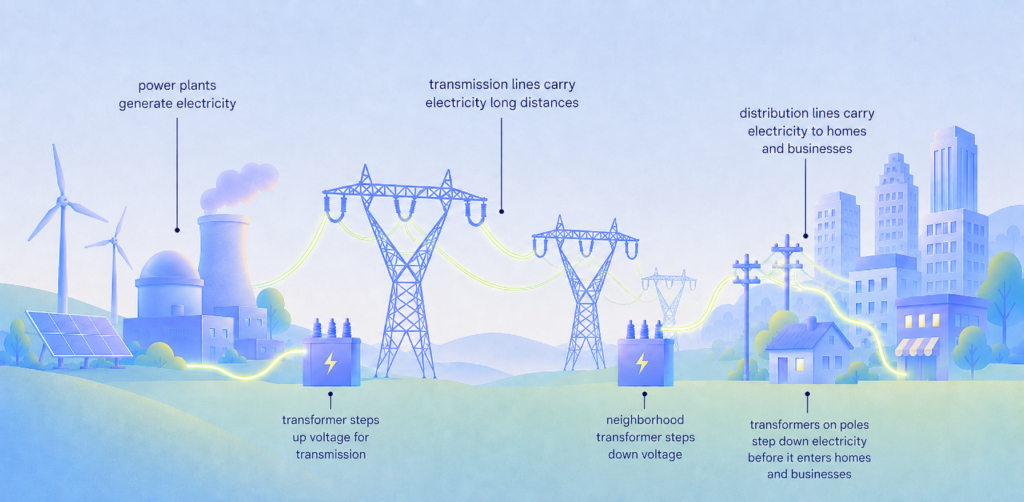
To understand why the current approach to planning grid infrastructure isn’t working, it’s helpful to understand how the electricity system operates. The figure below summarizes the three main components of the electric grid.
Electricity is generated from sources like fossil fuels, nuclear, and renewable energy. It then travels long distances over high-voltage transmission lines before being delivered to homes and businesses through local distribution lines.
What’s Wrong with How We Plan Electricity Infrastructure Today?
Currently, planning for grid infrastructure happens from the bottom up: transmission is largely planned utility-by-utility and state-by-state, with no single entity responsible for the interregional lines that connect different parts of the country. Generation is also planned at the state level, often around what is cheapest or easiest to build today rather than what the system may need a decade from now. The result is planning processes that are reactive, fragmented, and short-sighted.
Transmission Lines
Transmission lines carry electricity from where it is produced to where it is ultimately consumed. Often, the best places to generate power are far away from towns and cities. For this reason, interstate or interregional transmission lines are essential. Having enough transmission capacity is important for keeping electricity bills low, while maintaining reliability, because it allows regions to share resources during times of grid stress.
Most of the transmission projects built each year are smaller, lower-voltage lines within a single utility service territory. It is often difficult to plan high-voltage lines that cross transmission planning regions, because neighboring grid operators often disagree on optimal projects, while individual states can block proposed routes.
Fixing this process means moving from fragmented, bottom-up planning toward planning the system to support long-term reliability and affordability. One option is creating a National Transmission Authority: a congressionally authorized, federal entity empowered to plan, permit and finance high-voltage interregional transmission lines.
The authority could regularly publish a National Transmission Plan identifying priority transmission needs, solicit private developers to build those projects, and permit selected lines. And it would provide financial support, with the ability to use public financing that is cheaper than private debt. This would match the crucial role the government has played in developing other network infrastructure, such as railroads and the interstate highway system.
Power Generation
Generation faces a similar problem. In many states, utilities plan new generation assets through Integrated Resource Plans (IRPs), which tend to favor familiar technologies like natural gas. In restructured states, private developers compete in wholesale markets, which favors resources with low marginal costs, like wind and solar. Each model has strengths, but both can make it difficult to deploy newer, clean firm technologies such as advanced nuclear, next-generation geothermal, and long-duration energy storage.
Studies show that a decarbonized generation mix will require at least 25% clean firm power, to balance the variability of wind and solar and provide essential grid services. While early-stage clean firm technologies can be more expensive per unit of electricity, they will significantly reduce the cost of the overall system by reducing the amount of extra generation and infrastructure needed to maintain reliability. And, as we build more clean firm power projects, the costs per unit of electricity will decrease as the technologies reach commercial scale.
Leading technology companies are signing agreements to purchase power from these technologies, recognizing their importance in meeting rising demand. Yet more is required to commercialize clean firm resources at the pace we need.
The federal government should play a greater role in lowering the cost of clean firm power. One ambitious proposal would be the creation of a federal procurement standard to incentivize the building of power that is reliable, dispatchable, and emissions-free. Utilities should be required to buy more power from these resources over time. Under this approach, the U.S. Department of Energy could provide grants to utilities that meet annual clean firm targets, while collecting payments from those that fall short. These reliability-focused targets would create a clear demand signal for advanced technologies that will support a more reliable and affordable grid.
Planning the System Holistically
Transmission and generation get planned by different entities, on different timelines, with no shared picture of where supply or demand will materialize. That disconnect is expensive: transmission is built reactively, to address near-term, immediate needs. Developers site new power plants based on existing grid capacity, rather than optimal resource zones.
Instead, imagine we planned the grid holistically: designing it to unlock development. Transmission lines would be built proactively to serve future population centers and planned industrial hubs. Such planning regimes would identify the most promising locations for new power plants ahead of time. And to incentivize energy projects that serve a strategic national interest, the federal government could offer public land access, accelerated permitting processes, concessionary financing, or even equity stakes.
America can move beyond a reactive, piecemeal approach to planning and build the infrastructure needed to power the industries of tomorrow.
Getting planning right is the foundation. Next, we’ll look at how to finance advance energy technologies.