Each month, the CleanData team will publish an update to the Electricity Price Hub (EPH), our partnership with Heatmap News and MIT. The platform tracks monthly residential electricity rates and bills at the utility level across the country. These updates share what the data shows: where prices are moving, which utilities are driving changes, and what is behind the numbers. This is our August 2026 update.
—
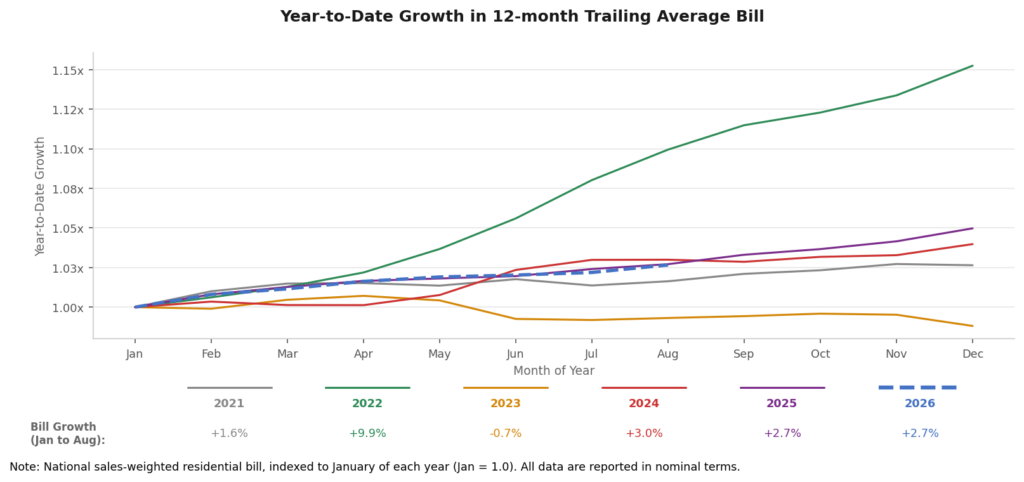
Average household electricity bills are up 2.7% from January through August 2026, adding $4/month to average bills, trending closely with growth in bills in 2024, and 2025 and outpacing 2021 and 2023 growth.
State and utility level trends
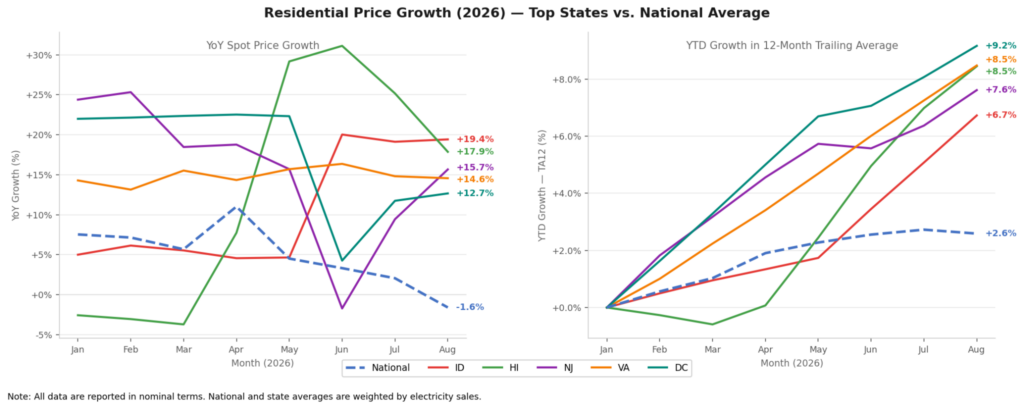
The above states have experienced the fastest year-over-year growth in rates in August 2026. See EPH updates from June and July, for additional detail on what is behind trends in these states.
Outside of these states, major utilities in New Hampshire, California, Maine, and New York have also experienced notable growth in average rates over the last 12 months. In California, two factors combined to push average rates charged by Southern California Edison, the state’s largest utility, up almost 15% (measured as a 1-year change in 12-month trailing average and representing the sales-weighted average rate across SCE’s different baseline allocation regions).
First, the California Climate Credit, through which the State distributes a portion of Cap-and-Invest revenues to customers twice a year, is lower this year than last. Second and more significantly, SCE implemented a new standard rate design for residential customers at the end of 2025 that substantially increased the monthly fixed charge portion of its delivery rates, while lowering the per-kWh portion. SCE suggested that the lower variable charges would largely offset the increased fixed charge for average customers, preliminary analysis suggests the larger service charge is pushing up average rates for typical SCE households. Excluding the climate credit, SCE’s August 2026 12-month trailing average delivery rate is up 13% compared to August 2025.
Other developments in August
Pressure from customers and policymakers over electricity affordability and the sustainability of recent rate trends has only grown in the first eight months of 2026. But at the same time, utilities face increased investment demands, rising costs, and in some cases, a profit motive and structural incentives to continue to invest. Under the circumstances, utilities are showing little sign of slowing down new rate hike requests, but some recent rate cases also suggest ways utilities may attempt to manage these competing pressures:
- Deferred bill impacts: On August 6, New Jersey’s Jersey Central Power & Light filed a rate case requesting a roughly $310 million increase in annual revenue, a change it estimates would increase average household bills by nearly 9%. However, responding to the intense focus in the state on rising electricity rates, the Company proposes offsetting a portion of the increase for residential customers until January 2028.
- Promised pause in rate requests: Utah’s regulator approved a settlement in Rocky Mountain Power’s long-running and contentious rate request, which it first filed in 2024. As part of the settlement, the utility agreed not to increase base rates again anytime before January 1, 2029.
- Rate stability tied to data center approval: Michigan’s DTE filed a rate case at the beginning of the year–its fifth since 2020. In the last month, the utility announced that it would delay its next rate case until at least 2028 so long as a data center it is supporting receives regulatory approvals and begins operation by the end of next year. (In parallel, the state regulator recommended that the state legislature ban annual rate cases, and at least one bill has been introduced that would limit).
- There have also been instances this year of utilities proposing rate hikes be phased in over multiple years or voluntarily reducing requested rate hikes mid case under pressure from customers and regulators.
Contact
For more information, feedback, or questions, please contact Lauren@cleanecon.org and Steven@cleanecon.org.