In our Blueprint to Transform SBIR, we laid out how the program has drifted from its original purpose and why that matters for the broader energy innovation pipeline. Our last post focused on how we got here. This one focuses on what it will take to fix it.
The changes required are structural. They shape how companies enter the system, how they move through it, and what happens once they receive funding. The goal is straightforward: create a program that consistently produces companies that can reach the market.
The Architecture of Reform
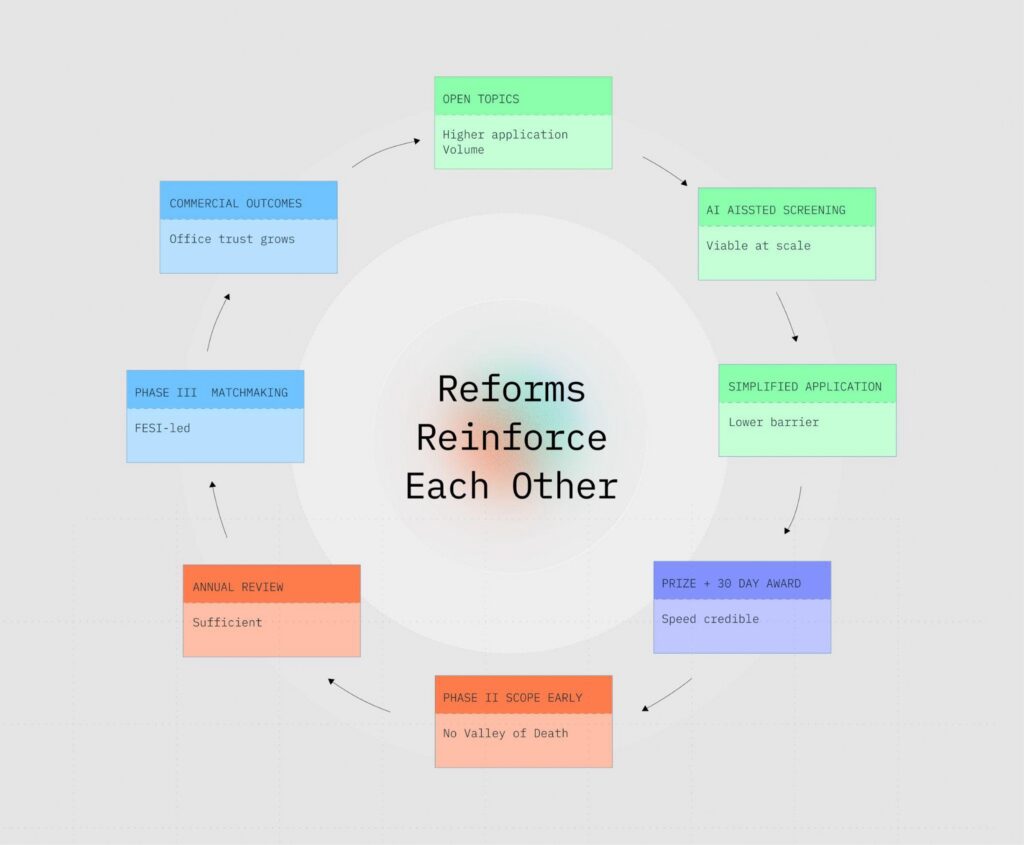
The blueprint’s ten recommendations are not independent improvements. They are a system, and the system only works when the full architecture is in place.
Design and management process.
- Bring in new management. Move SBIR’s institutional home from the Office of Science to the Office of Technology Commercialization (OTC), giving the program an explicit commercialization mandate and department-wide visibility.
- Determine roles and responsibilities. Establish clear lines of authority between OTC and technology offices.
- Reduce barrier to entry. Create a permanent open-topics track, at minimum 20% of total funding, so companies can propose solutions to broad energy challenges without forcing their work into narrowly defined government research priorities.
- Fixed application cycles. Lock the calendar: one solicitation per year, released in September, submissions in January, awards in April.
Application format and review.
- Right size the application. Rebuild it from the statutory minimum: approximately five pages and four core questions.
- Develop AI and operational infrastructure to manage application volume. Pair the simplified application with AI-assisted compliance screening and PIA-managed operational support so the program can handle a larger, more diverse applicant pool without overwhelming DOE staff.
Management mechanism.
- Simplify Phase I. Convert Phase I from a cost-reimbursable grant into a fixed-price prize. No expenditure reporting. Full $200,000 at award. This frees companies to work and eliminates months of administrative triage.
- Structure Phase II gate for commercialization progress. For Phase II, replace advancement based on “best efforts to complete technical goals” with advancement based on demonstrated technical and commercial milestones, negotiated during Phase I so there is no funding gap at the transition.
Connect and measure.
- Connect awardees to markets and capital. Launch a TABA voucher system so companies can access commercialization support of their choosing (customer discovery, investor introductions, IP strategy) rather than whatever vendor the agency has pre-approved. Establish a Phase III Buyers Alliance to create a structured pathway from SBIR into DOE’s procurement and deployment programs.
- Create effective evaluation metrics. Build data infrastructure to track commercialization rates, time-to-award, new-versus-repeat applicant success, and post-award revenue.
Why Everything Has to Change at Once
Partial implementation is likely to fail because these reforms are interdependent.
Open topics without OTC selection authority get captured by individual offices. Milestones without cooperative agreements revert to advisory guidance. A fixed calendar without prior-year funding collapses under the first continuing resolution. FESI without portfolio visibility cannot identify the companies it is supposed to connect with external stakeholders. Each element supports the others.
The blueprint recommends full launch in Year 1, accepting that some elements, particularly AI-assisted review and data infrastructure, will take two to three years to reach full capability. A program that launches the full design with developing infrastructure is recoverable. A program that launches fragments without the supporting architecture reverts to the status quo.
Why DOE Should Start Now
The majority of these reforms require DOE administrative action. Changes to application structure, topic design, review authority, award instruments, and post-award support can all be implemented through leadership decisions, internal policy revisions, or reallocation of existing staff time.
The convergence of conditions that makes this possible has not existed before. FESI is a new entity that can be leveraged. Partnership intermediary infrastructure is in place. AI tools capable of handling compliance screening at scale are available. Section 309 fund pooling provides budget flexibility that was not available in prior reform conversations. The people who built these tools, who stood up TCF, negotiated the first PIA agreements, and assembled the commercialization infrastructure this blueprint describes, are working within DOE right now.
Every cycle that passes without reform is another cohort of energy startups the program never reaches. They don’t appear in the data because they never entered. The cost is measured in technologies that did not deploy, markets that did not develop, and an energy transition that moved slower than it needed to.
Congress’ Recent Improvements to SBIR
The enacted Small Business Innovation and Economic Security Act, introduced by Senators Ernst and Markey extends SBIR through 2031 and makes several targeted improvements that complement the administrative reform agenda.
The most significant near-term change is TABA reform. The bill converts TABA from an agency-vendor model to an awardee-directed model and raises the Phase II cap to $50,000. It explicitly authorizes awardees to use TABA funds to hire staff to implement commercialization work, not just receive advice. This removes the primary structural barrier to TABA utilization that the blueprint identifies.
The bill also creates a Strategic Breakthrough Allocation: a new late-stage funding pathway allowing DOE and other large agencies to make awards of up to $30 million per company to Phase II graduates who can demonstrate matching private investment and market validation. No comparable mechanism has previously existed within the SBIR structure. Combined with Phase III training for contracting officers and standardized model contracts, this begins to build the downstream pathway the blueprint envisions. DOE has awarded exactly one Phase III contract — in the program’s entire history but that can change if this strategic breakthrough allocation is utilized.
However, the bill does not address the structural questions the blueprint focuses on. The management architecture, the application burden, the narrow topic structure, the absence of a centralized commercialization function. The bill improves SBIR’s instruments and incentives. It does not fix the institution. That work is administrative and dependent on DOE leadership choosing to act.
The combination is the pathway forward: full administrative reform launched in Year 1, reinforced by the legislation’s TABA redesign, Strategic Breakthrough Allocation, Phase III education, and new data infrastructure. With these combined reforms, companies building the next generation of energy technologies have access to an optimized program that can give them the support they need to launch them toward the market at a high speed.