The Department of Energy has built an impressive portfolio of tools to support energy innovators — programs, funding mechanisms, and institutions that span the full commercialization journey. Prizes, grants, loans, vouchers, cooperative agreements, national labs. On paper, it is everything a startup could need.
In practice, it is a labyrinth. There is no shared map across programs. No common vocabulary. No continuity for a company moving from one phase to the next. Every engagement requires starting from scratch — burning through capital and time navigating a system that was not built with founders in mind. For hard technology companies, the ones that have to invent, manufacture, and deploy physical systems at scale to solve real problems, that friction is not just an inconvenience. It can be fatal.
Fixing this requires starting somewhere. And for energy startups, the logical first lever is the program they encounter before any other: the Small Business Innovation Research (SBIR) program. It’s the entry point to DOE’s innovation ecosystem, which means its dysfunction compounds everything that follows. Reforms that make SBIR work better don’t just help early-stage companies clear the first hurdle; they improve the conditions under which the rest of DOE’s programs become accessible at all. That’s why CleanEcon’s first Blueprint is a complete, implementable redesign of DOE’s SBIR program.
SBIR Is Where It All Starts
For most early-stage energy startups, the front door to DOE’s support is the DOE SBIR program. SBIR funding is typically the first non-dilutive federal funding they can access – no equity stake, no cost-sharing mandate, no prior federal relationship required.
A Phase I award offers more than dollars, in theory. It’s a signal to investors, partners, and follow-on federal programs that DOE has vetted this technology and found it credible. That signal opens doors to national lab access, private capital, and federal development and demonstration programs across DOE and other agencies like the U.S. Department of Defense and the U.S. National Science Foundation. It shapes the narrative a company carries, the networks they can access, and their trajectory toward commercialization.
How well SBIR functions determines whether early-stage companies build enough momentum to grow beyond seed stage and reach DOE’s later-stage programs. This affects not just whether they succeed, but how quickly.
Which makes it all the more consequential that SBIR isn’t currently operating as impactfully as it could to put innovators on the fastest and most effective path to market.
One Program, Two Jobs
SBIR was created in 1982 to direct federal research and development (R&D) funding – across multiple agencies – toward small businesses and accelerate the commercialization of new technologies. The emphasis was always on getting innovations to market for the public good.
But over the decades, DOE’s SBIR program in particular has drifted toward something different. Today, many solicitations are narrowly specified around DOE’s own research or procurement agendas. Topics are often written to meet a program office or national lab need — not a market opportunity. That shift changes what the program rewards, and goes against Congress’s intent for the program.
By congressional mandate, SBIR is supposed to accelerate commercialization of energy technologies to help America produce companies and technologies that can compete in the market. Those are distinct missions with distinct standards of success. If SBIR is not deliberately oriented toward building market-ready companies, the United States risks slowing the deployment of critical energy technologies at a moment when speed, scale, and energy independence are central to national security and economic competitiveness. Restoring SBIR to its intended purpose is not a bureaucratic adjustment — it is a strategic necessity.
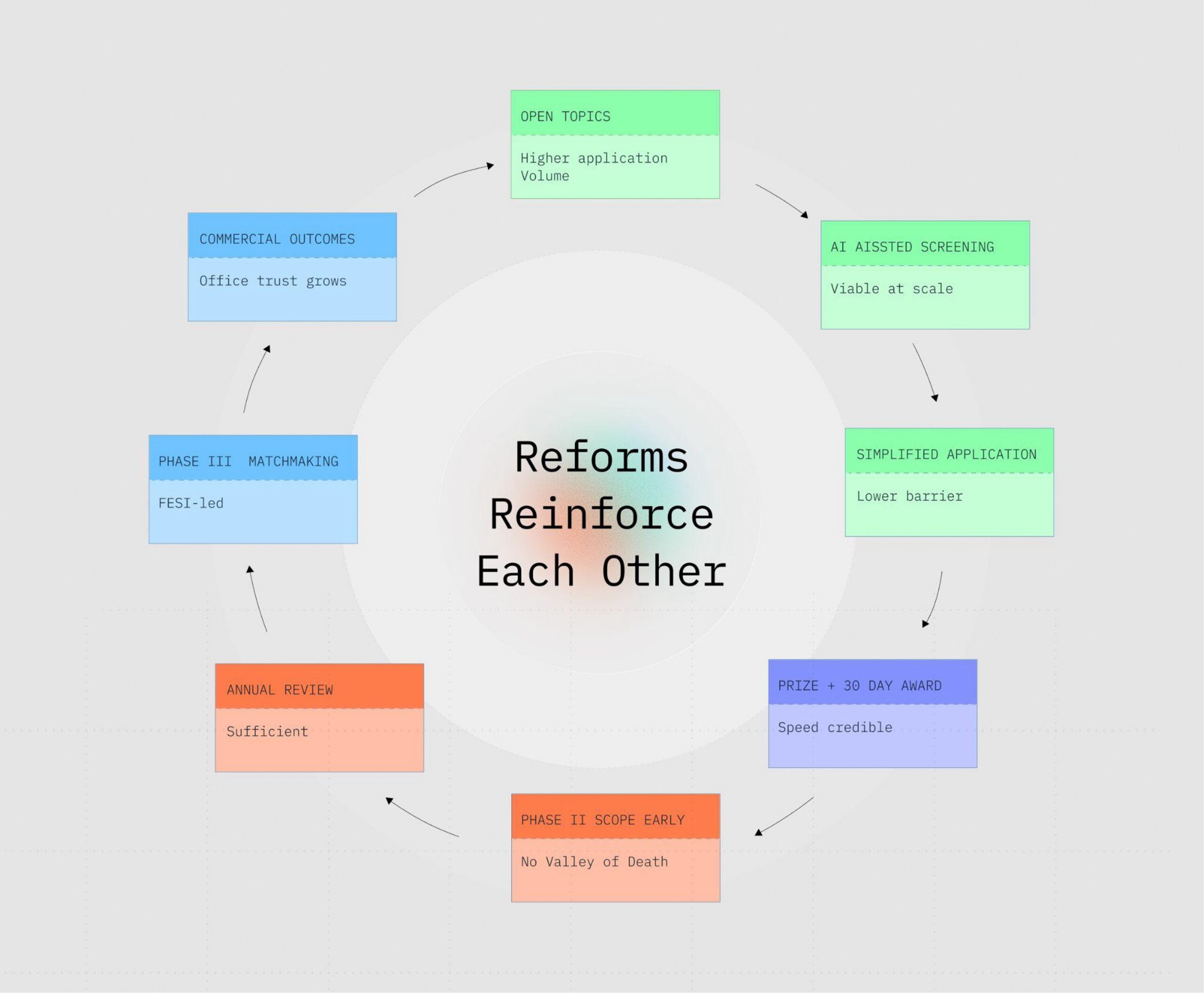
There’s also a deeper gap. Federal research funding rules make it nearly impossible to spend SBIR dollars on the activities that actually turn research into companies — customer discovery, team building, IP strategy, investor engagement, regulatory navigation. A company can advance technically through SBIR while its commercial foundations go completely unbuilt. The technology improves. The company doesn’t.
Design, Not Dollars
None of this requires more money to fix. DOE already has the authorities, assets, and talent to support energy startups far more effectively. What it lacks is a coherent architecture — one designed around how companies actually grow, not how federal programs happen to be organized.
That’s what CleanEcon’s first Innovation Initiative Blueprint is about. It lays out a concrete, implementable design for reforming SBIR: clarifying its purpose, aligning its structure with commercialization, shortening cycle times, and building the coordination infrastructure that connects the front door to what comes next.