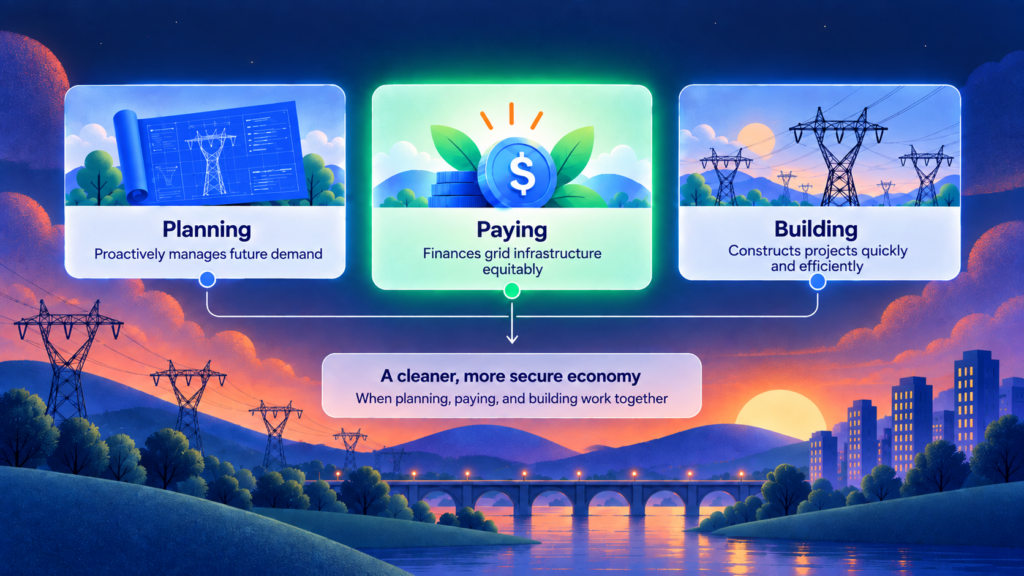
This is part two of a three-part series. Our first piece focused on planning the grid holistically. This blog focuses on ways to efficiently finance clean energy infrastructure.
America is entering an infrastructure buildout unlike anything since the post-WWII boom. Electricity demand is surging, driven by the rapid growth of artificial intelligence, semiconductor fabrication, advanced manufacturing, and other industries central to America’s economic and strategic ambitions. Meeting that demand will require adding more than 1,000 gigawatts (GWs) of new power generation over the coming decades, replacing hundreds of retiring power plants, and building or upgrading tens of thousands of miles of new high-voltage transmission lines — effectively doubling or tripling the size of our grid.
This will require an enormous sum of capital. JPMorgan estimates that investment in the U.S. electric grid is expected to hit $1 trillion in the coming decade alone.
Today, however, households and small businesses are increasingly feeling the burden of rising electricity costs. On average, utility bills are up by 33% over the past five years nationwide, adding $35 to household bills every month. Policymakers across the country are searching for ways to ease the pain.
Financing this buildout fairly is the central challenge. In this post, we offer some ideas on how to do it efficiently and equitably.
Transmission
Transmission is generally paid for by ratepayers, which means the costs of building or maintaining power lines are passed through by utilities to end-use customers. Every month, transmission and distribution charges show up as a portion of your electric bill.
There has been a lot of talk lately about making sure that data centers don’t add to utility bills (more on that below). But even without AI in the picture, our nation’s aging grid needs a generational investment to replace increasingly antiquated infrastructure. The question is how to fund it without putting the burden on individual households.
A few ideas:
- The government should continue to offer low-cost loans or grants for transmission expansion and upgrades. Increased financial assistance through opportunities like the Department of Energy’s SPARK program can help utilities meet rising electricity demand and reliability needs while lowering electricity costs for American households and businesses.
- Rising costs have also created interest in the concept of funding more transmission projects with public financing, such as project revenue bonds, rather than private capital. Analyses have shown that financing transmission infrastructure with low-cost, tax-exempt public debt is much cheaper than private debt or equity, potentially saving ratepayers billions.
- A Transmission Trust Fund would let the government finance nationally important transmission lines through a dedicated, self-sustaining revenue stream. One could imagine that hyperscalers and data center developers could be a major source of revenue into that fund. There’s a parallel here to the way we build interstate highways, with a federal cost share for major projects. In fact, when Congress passed the Federal-Aid Highway Act of 1956, the government agreed to pay for 90% of construction costs.
Shifting the costs of grid infrastructure away from the rate base could also help break the cost-allocation deadlock that has stalled permitting reform on Capitol Hill.
Generation
There is also an opportunity for the federal government to use concessionary financing to support new power plants. Low-cost loans or loan guarantees through the Energy Dominance Financing Program can help underwrite generation projects. We’ve seen a lot of action on nuclear fission under the Trump administration, but there are additional opportunities to support innovative, clean firm technologies such as geothermal or long-duration energy storage.
Federal ownership of strategic generation assets is another model. Take the PORTS-Pike Technology Campus in Ohio, being developed by SB Energy to power an OpenAI data center. This project will include a massive buildout of 9.2 GW of natural gas generation and will be owned by the federal government. Setting the politics of this specific deal aside, this framework opens a window to consider public ownership of strategic grid assets.
Public power helped us win WWII – providing the cheap electricity necessary to smelt aluminum for bombers and enrich uranium for the Manhattan Project. It’s worth examining again, for specific cases. Government ownership of strategic power plants would help alleviate costs otherwise passed on to ratepayers. A public-ownership structure for selected generation assets funded via equity stakes, federal loans, public debt, or revenue-driven sales (in the case of the Tennessee Valley Authority), would pass significant savings onto every household. This would eschew the shareholder interests of investor-owned utilities or private equity and instead place much needed emphasis on delivering affordable and innovative power.
AI Data Centers – The Elephant(s) in the Room
The buildout of AI data centers is becoming a highly controversial topic, with communities growing more and more concerned with rising electricity bills, noise, air and water pollution, and job impacts. Meanwhile, developers are becoming increasingly constrained by availability of electricity.
There’s an opportunity here to ensure that households and communities benefit when hyperscalers build their infrastructure. Call it a Grid Infrastructure Compact:
- Hyperscalers should be required to contract for, or build, additive clean power to support their operations. This is another major opportunity to derisk critical but nascent clean firm resources, potentially including extra supply that serves the broader public.
- They should pay for any and all network and transmission upgrades necessary to interconnect data centers to the grid. This is already being required in an increasing number of large load tariffs across the country.
- They should be required to sign community benefit agreements that invest in local priorities like public school systems.
- And they should be required to help fund nationwide grid infrastructure upgrades, perhaps through a federal excise tax, such as the one proposed by Senator Wyden (D-OR). This could support buildout of both transmission assets and innovative generation projects.
In exchange, the government could offer these good grid citizens a menu of benefits that enable “speed-to-power”: streamlined permitting regimes, faster interconnection studies, access to federal land, and low-cost financing.
Done right, this kind of compact lets the federal government, tech companies, and local communities partner together to ensure rapid and responsible development of hyperscale infrastructure, while facilitating larger societal benefits. With billions and possibly trillions of dollars moving into AI compute, we can leverage these massive investments to finally make possible the grid upgrades that our country has needed for years. Put another way: We must ensure that everyday citizens – and our electric grid – benefit from the AI race.
Next up, we’ll look at ways to accelerate the construction of critical grid infrastructure.