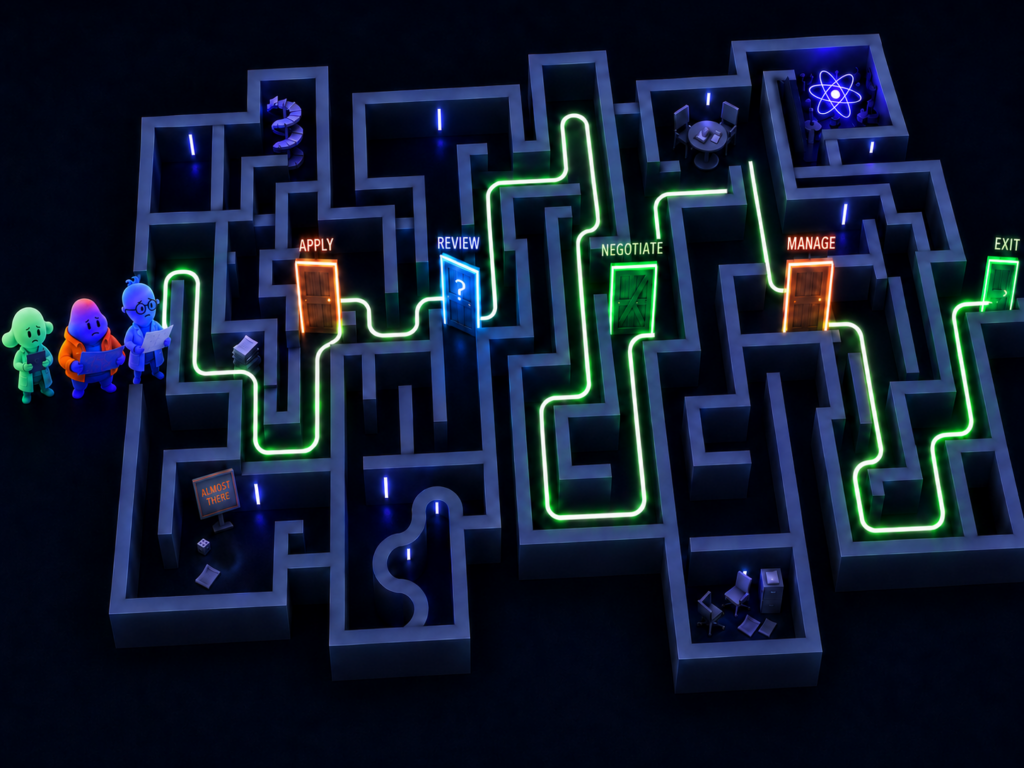
This is the second chapter of Cascade Materials, a fictional company, on the path from invention to industry, told alongside a new blueprint series on modernizing how DOE funds American innovation. Chapter One showed how seeking DOE support is more like traversing a dark, winding corridor than walking a straightforward path. Left unresolved, the best American breakthroughs could stall or lose to global competitors. This chapter starts at the first door: apply.
It is midnight on Thursday and one of Cascade’s founders takes a break from lab work to scroll LinkedIn. A former colleague has posted about a DOE solicitation. The award would be enough to build the pilot line. The application deadline is in fifteen days.
Her reaction is both excitement and frustration. This opportunity has been open for months and it is aimed essentially at what Cascade does. But she found it by accident, at midnight, in an acquaintance’s social media feed. How could this be?
The founder isn’t unique; this is the reality of many startups who have no single place to look for DOE funding opportunities. There isn’t a single place to search. No calendar of what is coming, no centralized alert , no navigator or central office to ask. The one thing that would have changed everything—knowing four months ago that this was coming—is the thing the system does not publish.
So they scramble. The solicitation lists everything the application must cover, then caps it at twenty pages. But the material they have prepared won’t fit within that limit and the announcement says very little about how reviewers weigh what they are reading. So, the founders cut, and every cut is a guess.
Cascade’s process sits close to the program’s stated area of interest without matching it precisely. The founders spend three days arguing about whether to describe their own company differently so it fits the language of the announcement.
How do reviewers assess a strong proposal? Which details are needed and which can go? How much of the space belongs to the technology, and how much to the business plan, their investors and potential customers, and their path to market?
New vocabulary arrives with every page. March-in rights. FOIA exposure. Cost share. Period of performance. Manufacturing restrictions. NEPA. They wonder whether they need a lawyer to apply. They wonder whether the proprietary details they are about to hand over can be pulled back out through a records request. They wonder when the money would actually arrive if they won, because they need it now. There is a contact listed on the last page they consider reaching out to, but it goes to a general inbox.
They submit with two minutes to spare on the closing afternoon. Three engineers have spent most of fifteen days on it, and nothing in the announcement shares any insight on whether they have high odds of success. They have bet two weeks of a three-person company on a shot in the dark.
But imagine if Cascade’s path to this point had looked different.
Imagine if, months before that midnight LinkedIn scroll, Cascade knew this opportunity was coming. If the founders had one place to find relevant funding, enough information to decide whether it was worth pursuing, and an application process designed so a three-person company could realistically compete.
Those changes address three barriers that Cascade encountered on its way to DOE’s front door:
- Awareness and Accessibility. Many companies that could contribute to national priorities never learn that DOE funding exists for their work. Opportunities are hard to find, schedules are not published in advance, and by the time a company hears about a solicitation, the window is often closing.
- Information, Understanding, and Trust. Some companies find federal funding opportunities but lack the information needed to make an informed decision about whether to apply.
- Application Burden and Narrow Topics. Others decide to apply but face disproportionate effort, unclear processes, and solicitation topics scoped too narrowly to accommodate their approach.
Now imagine that front door redesigned around the companies trying to walk through it. Five changes would have made Cascade’s experience very different:
- Digital Front Door: A Single Resource for Current and Future Funding
- Single Portal. A single searchable location for all DOE competitive funding across all mechanism types.
- Future Solicitation Schedule. A forward-looking schedule of planned solicitations six to twelve months out, transforming DOE from a system innovators must react to into one they can prepare for.
- Simplified, Standardized, and Transparent Application Architecture. Application requirements are right-sized to decision-essential information, with terms and conditions published alongside every solicitation and clear visibility into process and timeline from the outset.
- Funded Intermediaries for Outreach and Applicant Support. Systematic funding for organizations such as incubators, accelerators, or other entrepreneurial support groups that serve as a human front door, reaching innovators not actively searching for DOE funding and helping first-time applicants navigate the process. These intermediaries can also help companies navigate the complexity of managing federal awards, if successful.
- Staged Application Process with Concept Papers as Default. Lightweight first-stage submissions that protect applicant time, manage review volume, and give DOE an early signal on the expertise needed to evaluate full applications.
- Objective-Based Solicitation Tracks. Solicitations that define measurable outcomes without prescribing technology pathways, surfacing innovations DOE would not have thought to solicit directly.
Cascade would still have to compete, and DOE would still have to decide which technologies merit public funding. But Cascade would have known where the door was, what was on the other side, and what it would take to get through.
That is the front door we lay out in Opening the Front Door, the first blueprint in the series — and every recommendation in it is something DOE can do under existing authority.
Cascade’s application went through the first door. The next door is a black box. The merit review process is opaque for innovators that apply. Months will pass before anyone tells them anything and they rarely get feedback if they don’t make it through.
We will open the black box in our third chapter. Stay tuned.