As Director of Power Sector Decarbonization at the Clean Economy Project, Daniel Wolf focuses on the policy, financing, and deployment challenges that will determine whether the United States can decarbonize its power system while maintaining affordability and reliability.
In this Leadership Spotlight, Daniel shares where the power sector is hitting real constraints, the assumptions that deserve a harder look, and where policy can unlock durable progress.
What’s the biggest structural barrier standing between clean energy innovation and real-world scale, and how do we break it?
Financing. There is a valley of death between first-of-a-kind (FOAK) demonstration projects and commercial-scale deployment. FOAK is too expensive for venture capital, and too risky for infrastructure investors and traditional debt providers. If we want these technologies to scale, we need steel in the ground, and government funding is the most effective way to bridge that gap.
I would love to see the DOE’s Office of Energy Dominance Financing support a broad set of technologies. The retooled Section 1706 program that can support greenfield generation projects is exciting, particularly if it is applied to next-generation geothermal, advanced nuclear, long-duration energy storage, and natural gas projects paired with carbon capture and storage.
States can play a big role too. California and New York are paving the way by establishing procurement goals for new tech.
What assumption about clean energy or climate policy most needs to be challenged right now?
The assumption that a decarbonized grid should be achieved with 100 percent wind, solar, and batteries. To be clear, it is theoretically possible. But it would be economically disadvantageous.
Solar and batteries are cheap and quick to market. And we should continue to rapidly deploy renewables on the grid. But once you hit 60 to 70 percent renewable penetration, the cost of maintaining reliability rises exponentially. Even more importantly, the seasonal mismatch between renewable production and demand becomes a major cost driver. You end up needing to overbuild the system five times over to cover those imbalances.
The climate and clean energy advocacy community needs to embrace technologies it hasn’t always been comfortable with. That means being open to nuclear and natural gas that is paired with effective carbon capture. Most people are already there on long-duration storage, and increasingly geothermal. But we need a broader comfort level with clean firm options.
On that point: a lot of people see carbon capture and storage (CCS), as a lifeline for oil and gas companies. But the reality is there are already hundreds of gigawatts of natural gas plants in the development pipeline. LNG exports are also expected to double in the coming years. Natural gas is not going away.
The choice is not between gas and no gas. The choice is between a massive buildout of gas with no pollution controls, or a massive buildout of gas paired with pollution controls.
Where do you see the greatest opportunity to align policy, capital, and deployment to move faster?
Electricity affordability and reliability challenges, particularly in the PJM region, represent the most immediate opportunity. Consumers are seeing higher bills. Utilities and regulators are under pressure. Governors and other elected officials are paying close attention.
The short-term political response often centers on rate freezes and election-cycle relief. But this moment also creates space for bold policy ideas. Innovative market designs, federal financing tools, and state-level reforms all deserve consideration.
This is an opportunity to move beyond near-term fixes and toward a serious 20-year deployment strategy. Governors and members of Congress are engaged right now. The goal should be to translate that attention into a set of concrete reforms that can carry forward across multiple administrations.
What experience most shaped how you lead and make decisions today?
Throughout my career, I worked on transmission policy, including helping to stand-up a major grid modernization campaign back in 2020. Back then, the goal was to highlight that as renewables scale, lack of transmission capacity quickly becomes the binding constraint on the system.
That experience underscored the importance of politics. Transmission policy is complex, and most of our early outreach focused on friendly audiences. The effect of that was, over time, transmission became framed as a Democratic issue tied primarily to wind and solar, rather than as core infrastructure that enables growth.
That framing proved costly. During the 2023 debt ceiling negotiations, Republicans secured significant NEPA changes while transmission provisions were stripped out, despite serious momentum for reform. That was a serious missed opportunity.
Ironically, transmission was once viewed as a Republican priority. Times have changed. But the lesson was clear: durable infrastructure reform requires bipartisan support from the start.
What should the next generation of environmental advocates focus on now to drive durable impact later?
Scaling clean firm power. Many of the technologies we need are not yet proven at commercial scale. We need more demonstrations and more steel in the ground. Costs will come down with deployment and learning, but that will take five to 10 years.
That timeline matters. Five to 10 years from now is when renewable penetration will start to reach levels where system reliability becomes much more expensive without firm clean capacity. The advocacy focus now should be on making sure those technologies are ready in time.
Put another way: if we don’t invest the time and effort now to scale dispatchable, emissions-free tech, the majority of future demand will be met by unabated natural gas.
What’s the hardest tradeoff in power sector decarbonization that we’re not being honest enough about?
The tension between near-term affordability and long-term decarbonization.
Electricity prices matter, and households are feeling real pressure. At the same time, deferring needed infrastructure investment only pushes costs into the future. Aging plants are retiring, demand is rising, and the system requires expansion.
A fully decarbonized economy will need three to four times more power to support electrified buildings, transportation, and industry. That expansion comes with real costs. A key question is how those costs are allocated.
Removing certain infrastructure costs from the rate base and addressing them via public financing mechanisms is part of the answer. And of course we need to make sure that costs associated with AI buildout are truly borne by data center developers. But at the end of the day, a historic, long-term investment is unavoidable. The focus should be on fairness and durability.
Where can policy unlock the biggest near-term gains for a cleaner, more reliable grid?
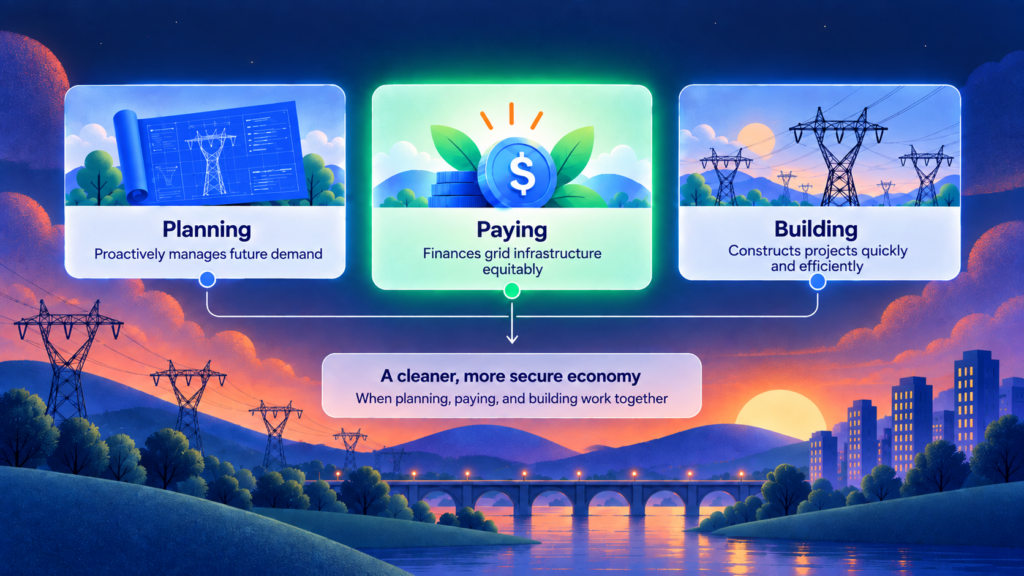
First, permitting and siting reform. We have to build much faster across the power system, not just new generation. That means investing in the enabling infrastructure, especially transmission and pipelines.
Today, much of the transmission being built is incremental and local, rather than high-voltage regional lines that unlock geographic diversity and system flexibility. Proactively building transmission at scale would also help clear interconnection queue backlogs.
Transmission can no longer be just about wind and solar. Every single generation type benefits from an expanded grid. Just ask any nuclear or geothermal developer that is actively trying to site a project.
Second, federal financing. Deployment will accelerate when financing is treated as a comprehensive federal strategy rather than as a collection of siloed programs. A coordinated, whole-of-government de-risking approach can unlock faster progress.
Third, wholesale market redesign. Today’s capacity markets were built for a different era. Development timelines now stretch close to a decade due to supply chain constraints, interconnection delays, permitting, and financing conditions. Market signals need to reflect that reality.
Fundamentally, markets need to be sending longer-term demand signals. Hyperscalers and big tech have been doing important work by signing novel offtake agreements for innovative technologies. But at the end of the day, states need to play a stronger role in long-term procurement, especially since they have jurisdiction over generation planning and siting.