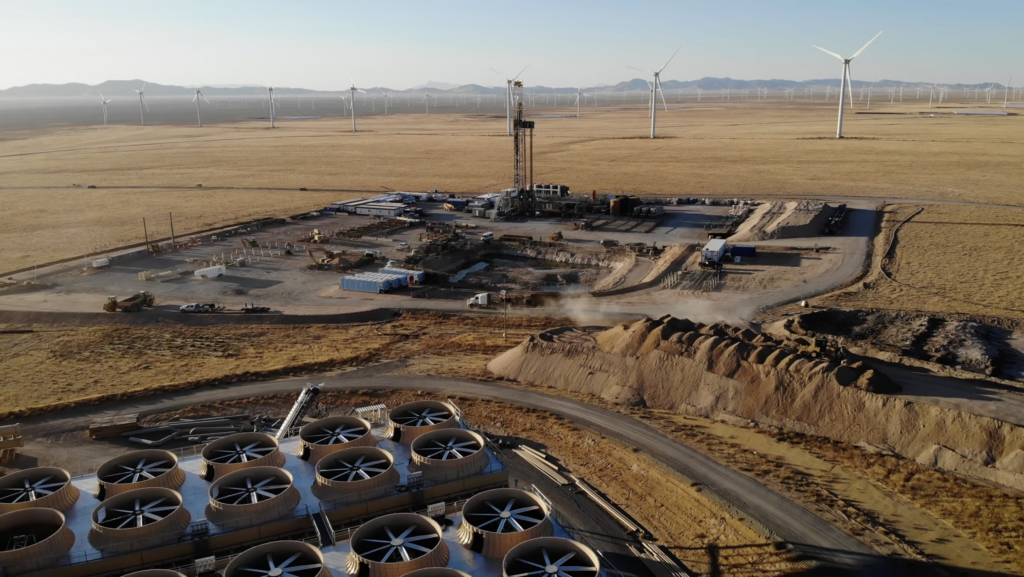
Next-generation geothermal is on the verge of commercial readiness. Developers are drilling hotter and deeper. Startups continue to sign offtake agreements. And Fervo’s Cape Station project is set to begin delivering power early next year. Meanwhile, costs are projected to fall by as much as 80% in the coming decade.
These are promising developments. In the face of explosive demand growth, our nation will need to deploy as much clean firm power as it can get. Next-generation geothermal, and enhanced geothermal (EGS) in particular, will be valuable for providing round-the-clock, emissions-free power to fuel new industrial facilities and maintain grid reliability.
The question is no longer about technology. Instead, it’s about where EGS, a technology that uses advanced drilling techniques to access underground heat, is most cost-effectively deployed.
Today, project development remains slowed by the high up-front costs of resource appraisal for commercial viability. Traditional capital providers will not fund geothermal projects without a complete assessment of subsurface conditions. But obtaining this data requires exploratory drilling, a costly but critical activity. Each site is geologically distinct, which limits how much can be learned from one location and applied to the next.
Accelerating EGS Deployment
To address this binding constraint, we are proposing a Geothermal Appraisal Risk Program (ARP) at the Department of Energy (DOE) to provide concessionary support for resource confirmation drilling across a diversified portfolio of geologic basins.
Developed in partnership with Waypoint Strategy Group, this program proceeds in three stages: 1) program design, 2) program execution, and 3) evaluation.
This program builds on recent progress at DOE. In February, the Office of Geothermal (OG) announced a funding opportunity providing up to $71.5 million for resource exploration, characterization, and confirmation drilling. And in March, Senators Hickenlooper and Daines introduced the bipartisan Geo POWER Act, legislation establishing a Milestone-Based Geothermal Demonstration Program to leverage innovative financing approaches.
The Geothermal ARP complements both efforts. It is designed to amplify DOE’s existing solicitation, which funds resource characterization at individual sites, by supporting later-stage, multi-well campaigns. Further, it provides DOE with the architecture for a future milestone-based demonstration program authorized by the Geo POWER Act. It maps directly to the priorities in the bill, including a requirement to fund projects in multiple states, as well as requirements around data sharing.
Program Design
We envision a program with a total authorization between $200-$400 million. At $20-$40M per site, we anticipate this could initially support 5-20 distinct locations. Specific cost-share requirements should remain flexible for small and emerging developers.
To safeguard the use of public funds, we propose that eligible projects demonstrate technical documentation of resource potential, developer capacity, and a commitment to data-sharing.
Importantly, projects completing characterization work under the existing DOE funding opportunity would be eligible for appraisal-stage support under the ARP, creating a clear federal pipeline from exploration to confirmation to demonstration.
Ultimately, the Geothermal ARP is mechanism-agnostic by design. Potential financial instruments include cooperative agreements, concessionary loans, the use of Other Transactions authority, and other blended approaches. We recommend that the national laboratories be leveraged for technical validation, modeling, and data management, while OG, and other relevant offices be involved in designing the ultimate execution vehicle.
Conclusion
Given the right set of market conditions, next-generation geothermal could provide 90 GW or more of electricity, enough to power tens of millions of homes by 2050. There is a near term opportunity for the federal government to accelerate this timeline.
We believe the ARP outlined is well suited to address the high-upfront costs of characterization drilling required to improve subsurface knowledge; this will ultimately unlock institutional investment in this promising resource.
Read the full program proposal here.